| |
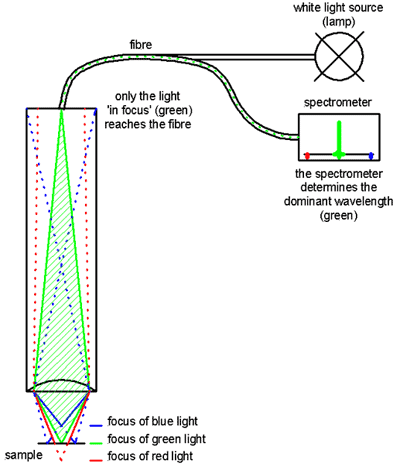
This sensor type exploits the dependency of the focal length of the
object lens to the wavelength of the light (chromatical aberration,
or axial colour). The light of a broadband source (tungsten halogen
lamp) is directed by a multimode fibre to the sensor head. The head
is purely passive, and usually consists of two or more lenses. The
object lens focuses the light towards the sample. Since the system
is intentionally not corrected for axial colour, the focal length
of blue light is shorter than the focal length of red light, so the
white light is separated along the optical axis in order of increasing
wavelength (ie colour, from blue to red). Radiation reflected from
the surface is collected by the very same object lens, and the light
is fed back into the multimode fibre again. This is the reverse process
of the imaging described above, and also works best for the wavelength
which is in-focus.
On the way back, the radiation directed into a spectrometer. The sensor's
electronics determine the wavelength of the signal's maximum. The
profile value is a function of the dominant wavelength. |
|
|
 |
|




