| |
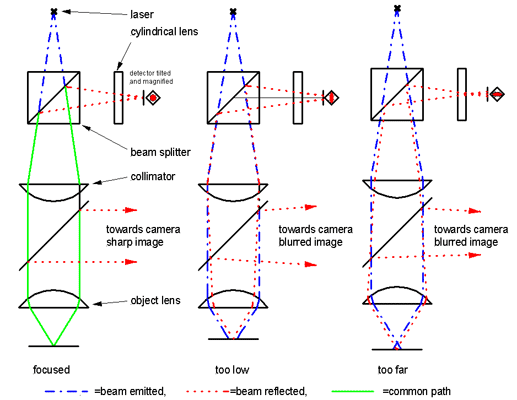
The light source is projected by the object lens on the sample's surface.
The reflected light is collected by the very same lens, focused by
the collimator lens and deflected towards the detector by a beam splitter.
In the absence of the cylindrical lens, the light would converge to
a tiny spot on the detector. The cylindrical lens deviates only one
axis of the light, so a horizontal and a vertical focal line originate
from the single spot. The detector is placed mid-way between the two
focal lines.
A circular spot appears on the sensor if the surface is exactly in-focus.
Deviation from the focal position results in an elliptic spot on the
detector. The orientation and eccentrity of the spot depends on the
magnitude and direction of the defocus.
The spot's shape is detectable by the current distribution in a photodiode
array. The sensor's electronics generate an error signal resulting
in a movement of the object lens to track the surface at exactly the
focal distance. The motion of the lens is monitored by an incremental
encoder (glass scale), comprising the profile signal. |
| |
 |
|




