| |
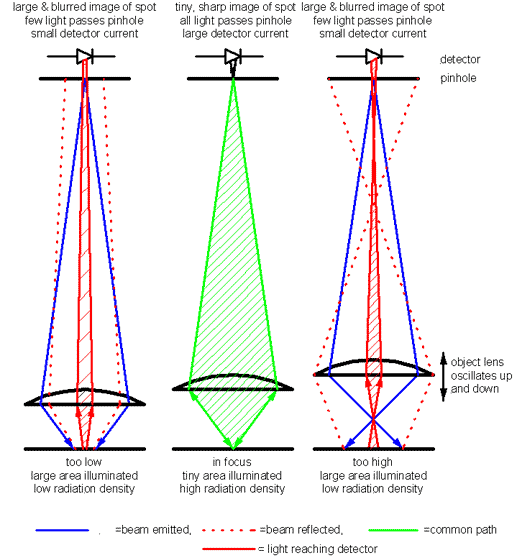
The light source is projected by the object lens on the sample's surface.
The reflected light is collected by the very same lens, focused by
the collimator lens and deflected by a beam splitter towards a tiny
detector. The object lens continuously scans the measurement range
of the sensor. The illumination density is extraordinary high if the
sample's surface is exactly in-focus. Due to the conical shape of
the light leaving the object lens, the illuminated surface increases
with the square of the displacement and the illumination density decreases
by the same order. The image of the illuminated surface is projected
onto the detector. In the surface is exactly in-focus, all of the
light of the image reaches the detector. In case of de-focus, the
energy is distributed in a large area around the detector, leading
to a small detector signal. The imaging back on the detector also
exhibits quadratic decay beyond the focus. Altogether, the optical
properties result in a pronounced intensity signal at the true focal
position.
In the confocal sensors, the object lens oscillates over the whole
measurement range. The sensor's electronics determines the instant
of the detector's signal maximum and calculates the profile value. |
|
|
 |
|




